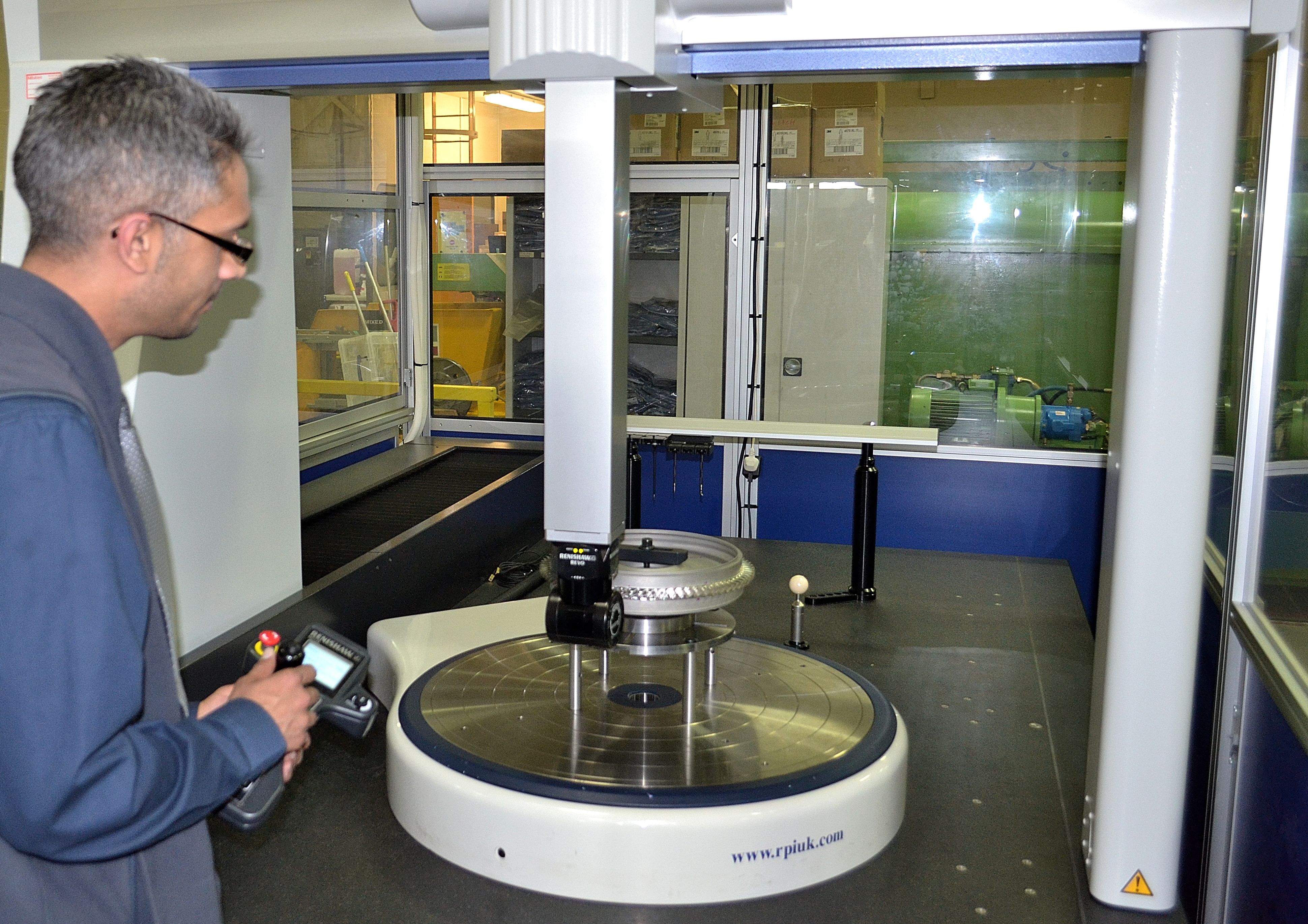
What are the Best Practices for Optimizing CMM Inspection?
- Aligning the component’s axis of rotation with the rotary table axis to eliminate eccentricity errors and ensure consistent measurement results.
- Designing inspection routines so that the probe remains as close to the measurement feature as possible, using rotary motion to bring features into position.
- Standardizing inspection programs using automated rotary positioning to ensure repeatability and reduce operator influence.
- Increasing data sampling density for critical features to gain a more complete understanding of part geometry and detect early-stage defects.
- Leveraging software to automate analysis and reporting, reducing manual interpretation and enabling faster, data-driven quality decisions.
Coordinate Measuring Machines (CMMs) are essential for inspecting complex parts across aerospace, automotive, and advanced manufacturing. However, traditional CMM setups can become inefficient when measuring round or multi-sided components.
By integrating our precision rotary systems, manufacturers can significantly improve inspection speed, accuracy, and flexibility.
Use a Rotary Axis for Symmetrical Parts
If a component has rotational symmetry—such as shafts, gears, bearings, or turbine disks—a rotary axis can fundamentally improve the inspection process.
By integrating a precision rotary table from Rotary Precision Instruments UK Ltd:
- The part can be rotated through a full 360° while maintaining highly accurate angular positioning
- Features can be measured in a continuous sequence rather than through multiple probe repositioning steps
- Complex multi-angle inspections can be completed in a single setup
RPI systems offer arc-second level angular accuracy and repeatability, ensuring the part remains precisely positioned throughout inspection.
Minimize Probe Travel Distance
Long probe paths introduce multiple sources of measurement error, including:
- Thermal variation across the CMM structure
- Probe deflection from extended stylus configurations
- Increased positioning uncertainty over long travel distances
Using a rotary axis allows the part to be repositioned instead of the probe, significantly reducing linear movement.
RPI’s low-profile rotary tables are specifically designed to:
- Reduce the impact on available CMM measurement volume
- Enable shorter, more direct probe paths
- Maintain high stiffness and stability during measurement
Automate Measurement Sequences
Manual inspection routines increase variability and reduce throughput. Automation improves both consistency and efficiency.
RPI rotary systems support step-and-repeat positioning, allowing:
- Predefined angular increments for feature inspection
- Automated sequencing of measurement points
- Consistent inspection routines across multiple parts
This is especially valuable for:
- Equally spaced features (e.g., bolt patterns, gear teeth)
- Repetitive production inspection
- High-volume manufacturing environments
Capture More Data Points
Traditional inspection methods often rely on limited measurement points, which can miss subtle geometric deviations.
Rotary metrology enables high-density data collection by:
- Continuously scanning features as the part rotates
- Capturing thousands of data points per revolution
- Providing a complete profile of circular geometry
This level of data improves the analysis of:
- Runout (radial and axial)
- Roundness and circularity
- Concentricity and eccentricity
- Form errors across the full surface
Integrate Measurement Software
Advanced software plays a critical role in transforming raw measurement data into actionable insights.
RPI systems integrate with metrology software platforms that enable:
- Real-time data acquisition and visualization
- Automated calculation of circular geometry parameters
- Custom inspection templates for repeatable workflows
- Reporting and data sharing across teams and suppliers
Software solutions such as Sylcom and MeasurementDESK support:
- Multi-channel data capture
- Rotary encoder integration
- Detailed analysis of rotational behavior